


What changed for Executive Condominiums from 8 May 2026
On 8 May 2026, the Ministry of National Development announced a major tightening of the Executive Condominium framework. Based on public reporting, the changes apply to EC Government Land Sales sites with tender closing dates on or after 8 May 2026. This means the trigger is not simply the eventual project launch date.

| Rule | Old EC framework | New EC framework |
|---|---|---|
| Minimum Occupation Period | 5 years from TOP | 10 years from TOP |
| Full privatisation | After 10 years | After 15 years |
| First-timer quota | 70% reserved for first-timers for the initial sales period | 90% reserved for first-timers for 2 years |
| Deferred Payment Scheme | Available if offered by the developer | Removed |
| Payment scheme | Normal Payment Scheme or Deferred Payment Scheme | Normal Payment Scheme only |
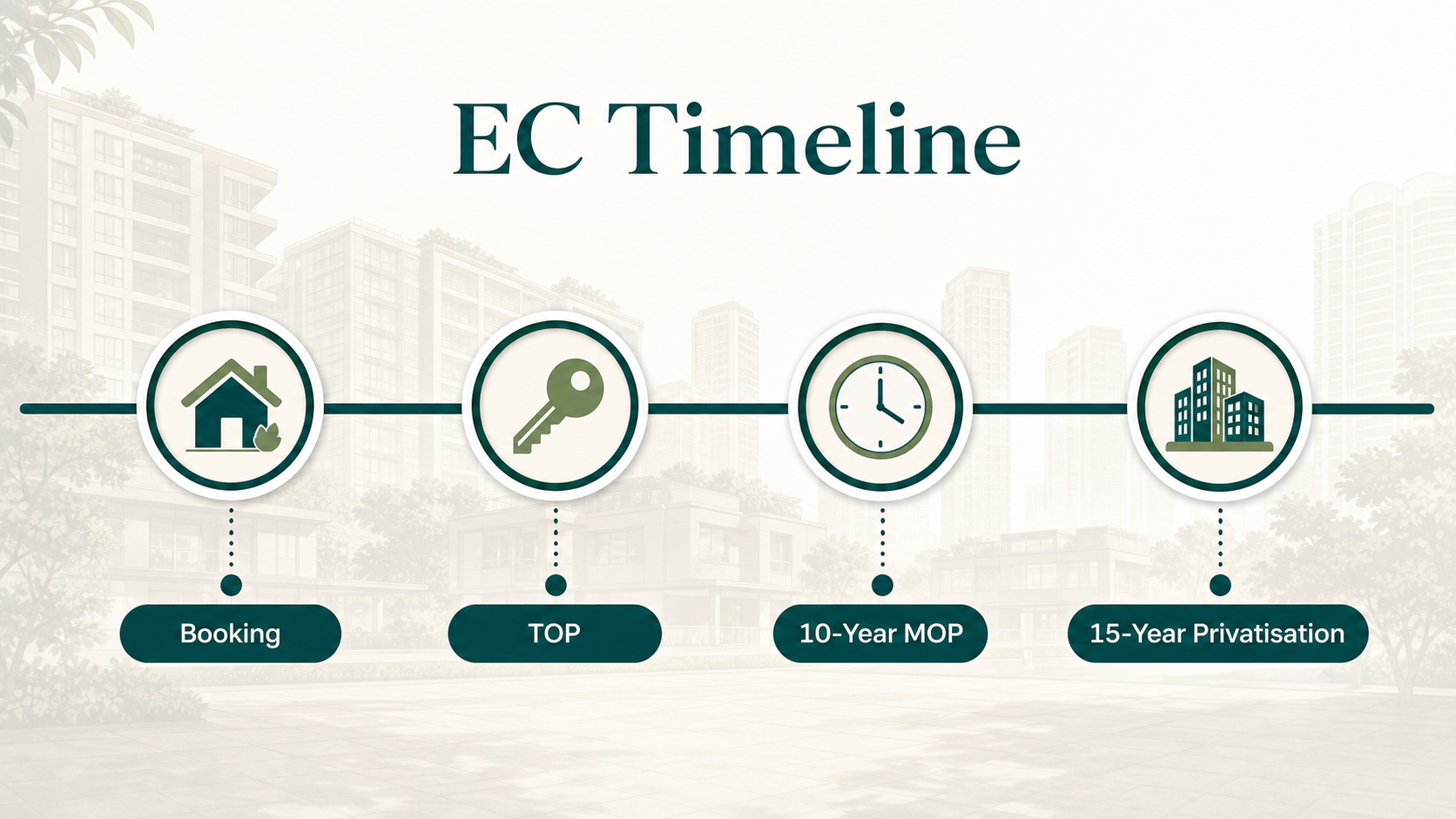
The new MOP means buyers must occupy the EC for 10 years from TOP before they can sell it to Singapore Citizens or PRs, rent out the whole unit, or buy another residential property. Full privatisation now happens only after 15 years, after which the EC can be sold to any buyer, including foreigners and corporate entities, subject to prevailing laws and buyer eligibility.
Developers can also no longer offer the Deferred Payment Scheme. Buyers must plan for progressive payments under the Normal Payment Scheme, which makes cash flow more important for HDB upgraders and second-timers.
Why the Government made the change
The policy direction is clear: ECs are being repositioned as long-term homes for owner occupation, rather than a short-cycle upgrading or investment play.
Prices have moved up sharply
CNA reported that the median new EC price from January to April 2026 was S$1,843 psf, compared with S$782 psf in 2016. At S$1,843 psf, a 1,000 sq ft EC would be about S$1.84 million before buyer stamp duties and other costs.
First-timer share has fallen
National Development Minister Chee Hong Tat noted that first-time EC buyers made up about half of EC buyers in 2020, but fell to about 30% to 40% in 2024 and 2025.
Many owners sold soon after MOP
From 2021 to 2025, about 75% of ECs sold on the open market were transacted within five years after MOP, compared with about 45% in the preceding five-year period.
DPS reduced short-term cash pressure
The Deferred Payment Scheme previously allowed buyers to delay most of the purchase price until TOP. CNA reported that DPS buyers generally paid a 2% to 3% premium over the EC purchase price.
Immediate market impact
| Group | Likely impact |
|---|---|
| First-time buyers | Stronger access because 90% of units are reserved for first-timers for two years. Eligible EC buyers may also receive a CPF Housing Grant of up to S$30,000 when buying from a developer. The trade-off is a much longer stay-and-hold commitment. |
| Second-timers and HDB upgraders | Hit hardest by the lower available quota and removal of DPS. Progressive payments under the Normal Payment Scheme require tighter cash-flow planning. |
| Developers | May bid more cautiously for future EC land if the buyer pool is narrower and the investment angle is weaker. MND has publicly said it hopes the measures will help moderate land bids and EC prices. |
| Old-rule EC projects | Projects whose land tenders closed before 8 May 2026 may become more sought after because they are expected to remain under the previous framework. |
Public reports have identified Senja Close, Sembawang Road, Miltonia Close, and two Woodlands Drive 17 EC sites as examples of upcoming projects not expected to be subject to the new rules because their tenders closed before 8 May 2026. Buyers should still verify the applicable framework with the developer and official project documents before committing.
Impact by buyer type
| Buyer type | Impact | Best planning approach |
|---|---|---|
| First-time buyer buying for own stay | Positive, provided the family is genuinely long-term. | Choose location, schools, transport, unit size, and family suitability carefully. |
| First-time buyer seeking quick capital gain | Negative. The old 5-year MOP strategy is much weaker. | Compare resale ECs after MOP, private resale condos, or smaller private new launches. |
| HDB upgrader or second-timer | Strongly negative because allocation and cash-flow flexibility are reduced. | Compare old-rule ECs, resale ECs after MOP, and private resale condos. |
| Investor-minded buyer | Negative. Liquidity, rental flexibility, and exit timing are all weaker. | Consider private condos, resale private property, REITs, or other property-linked assets. |
| Developer | Mixed. Genuine family demand may remain, but upgrader-driven pricing is less certain. | Bid more conservatively and design for families who intend to occupy long-term. |
Practical plans and alternatives
Plan A: Buy an old-rule EC before the window closes
Suitable for HDB upgraders, second-timers, or first-timers who value a shorter MOP and earlier privatisation. The risk is overpaying because many buyers may crowd into the same projects.
Plan B: Buy a new-rule EC only as a long-term home
Suitable for young couples and families who want condo-style living and can see themselves staying for at least 10 years after TOP.
Plan C: Buy a resale EC after MOP
A practical alternative for buyers who want EC-style facilities without starting a fresh 10-year MOP from TOP. Check maintenance, renovation needs, and lease age.
Plan D: Buy a private resale condo
Suitable for buyers who need flexibility. Private condos have no EC MOP, although Seller's Stamp Duty and ABSD planning still matter.
Plan E: Stay in HDB and invest surplus cash elsewhere
This may suit conservative households or families uncertain about future plans. It preserves liquidity and reduces the risk of overcommitting.
Plan F: Consider BTO, Sale of Balance, or resale HDB
For first-time families, HDB may still be more financially sensible. EC grants can help, but HDB resale grant support may be stronger depending on eligibility and flat type, with the CPF Housing Grant for eligible families going up to S$80,000.
Strategic interpretation
The policy reset reduces the old EC arbitrage. Previously, the EC story was: enter at a discount to private condos, enjoy condo-style facilities, fulfil the 5-year MOP, then sell into a broader resale market. The new rules weaken that short-cycle strategy.
The EC is now closer to a long-term subsidised private-style home than a quick upgrading asset. For buyers, the core question is no longer just whether they can afford the EC. It is whether they can live with that EC as their family home for the next 10 to 15 years.
Before comparing new ECs, resale ECs, private resale condos, or staying in HDB, run your income, debts, loan amount, and tenure through our Residential Home Loan Calculator to estimate TDSR, MSR, LTV, and monthly repayment.
- First-time buyers benefit most if buying for own stay and long-term stability.
- HDB upgraders and second-timers need stricter cash-flow planning without DPS.
- Investors should treat new ECs as much less flexible than before.
- Developers should expect a more home-owner-led buyer pool.
Consult with MortgageLogic Advisory
Plan your EC financing before committing
EC affordability is now more than a monthly instalment question. The new timeline affects cash flow, resale timing, upgrading plans, and family flexibility.
| Review area | How MortgageLogic Advisory can help |
|---|---|
| Affordability and TDSR | Estimate loan quantum, monthly instalments, and likely TDSR position before booking. |
| Cash-flow planning | Compare Normal Payment Scheme milestones against available cash, CPF, and sale proceeds. |
| Upgrade route comparison | Compare new EC, legacy EC, resale EC, private resale condo, and staying in HDB. |
| Exit timeline | Map the practical difference between booking date, TOP, MOP completion, and full privatisation. |
| Bank package review | Shortlist suitable home loan options and highlight refinancing considerations after TOP. |
Important note
General information only
This article is for general information only and does not constitute financial, legal, tax, property, or investment advice. EC eligibility, grants, project rules, loan approval, and payment schedules can change depending on official policy, developer documents, and bank assessment.
References
